

A Message from Evolution Edges
If you work in winter maintenance, you have probably heard a lot about tungsten carbide lately. Pricing, availability, lead times and supply chain concerns have become some of the biggest conversations in the snow and ice industry since the end of the 2025–2026 winter season.
Tungsten carbide has long been the standard for high-performance snowplow cutting edges because of its exceptional hardness and wear resistance. But today's market is forcing manufacturers and fleets to take a closer look at their dependence on this material.
This Is More Than a Price Increase
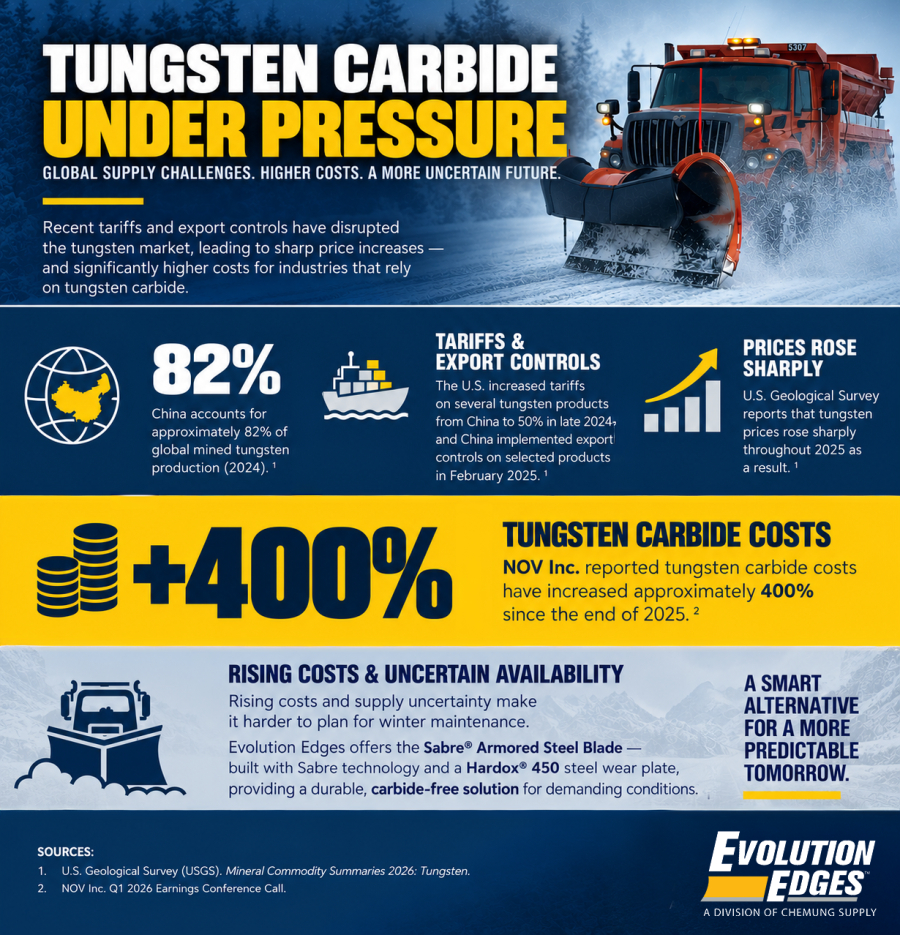
The current tungsten carbide situation is tied to a much larger global supply chain issue. China dominates global tungsten production, accounting for approximately 82% of mined production in 2024, according to the U.S. Geological Survey (USGS). [1]
In late 2024, the U.S. increased tariffs on several tungsten products from China to 50%, and China implemented export controls on selected tungsten products in February 2025. USGS reported that tungsten prices rose sharply throughout 2025 as a result. [1]
The impact has continued into 2026. In its first-quarter 2026 earnings conference, NOV Inc. reported that its tungsten carbide costs had increased approximately 400% since the end of 2025. [2]
That figure reflects NOV's own tungsten carbide costs—not a 400% increase across every carbide product or snowplow blade—but it illustrates the scale of the cost pressure facing manufacturers that rely on tungsten carbide.
For winter maintenance professionals, the issue goes beyond the price of a cutting edge. Rising costs and uncertain availability can affect purchasing decisions, inventory planning and the ability to have replacement blades available when they are needed most.
An Industry Crossroads
Carbide remains an excellent wear material, and we continue to manufacture carbide-equipped Sabre blades for applications where that performance is the right choice. But we also believe the current market creates an opportunity to look at alternatives.
That is why we developed the Sabre Armored Steel Blade.
Rather than simply accepting higher carbide costs, we went back to the engineering behind the Sabre platform and asked how we could create a durable, high-performance blade without tungsten carbide.
The result is a carbide-free solution designed to give fleets another option while reducing their exposure to the volatility of the tungsten market.
Introducing the Sabre Armored Steel Blade
The Sabre Armored Steel Blade is built on the patented Sabre® blade platform and combines a 3/4-inch 1020 steel blade body with a fully welded 3/4-inch Hardox® 450 armored wear plate. Built with bulletproof tested materials, the Sabre Armored Steel Blade is engineered for demanding applications where strength and durability matter.
Hardox® 450 provides the hardness and abrasion resistance needed for demanding winter applications, while the fully welded construction creates a durable, integrated wear system. The design delivers measurable performance advantages over standard steel, including twice the hardness, 70% greater tensile strength and 140% greater yield strength. It also incorporates built-in wear indicators and eliminates the need for tungsten carbide inserts.
The result is a blade designed around cost predictability, material independence and long-term fleet planning—without requiring fleets to rely on a material whose price and availability are increasingly difficult to predict.
.
Carbide Isn't the Only Answer
We are not suggesting that every fleet should replace carbide. Different roads, equipment and operating conditions require different solutions, and carbide remains the right choice for many applications. That is why the Sabre family offers multiple options.
The Sabre Armored Carbide Blade combines carbide inserts with a Hardox® 450 armored cover plate for fleets that want the benefits of carbide wear technology.
The Sabre Armored Steel Blade provides a carbide-free alternative for fleets looking for greater cost predictability and less exposure to the current tungsten market.
The right answer depends on the application, and having options allows fleets to choose the technology that makes the most sense for their operation.
Plan Before Winter Arrives
Ready to Rethink Your Blade Strategy?
If your fleet is facing rising carbide costs, uncertain availability or simply wants to explore a carbide-free alternative, we'd welcome the opportunity to talk through your application.
Ask the Evolution Edges team whether the Sabre Armored Steel Blade could be a fit for your fleet.
Sources
[1] U.S. Geological Survey, Mineral Commodity Summaries 2026: Tungsten.
[2] NOV Inc., Q1 2026 Earnings Conference.


